SOP template
A standard operating procedure turns a task that depends on one person's memory into a repeatable process anyone on the team can follow. This template gives you the sections an SOP needs, what each section is for, and the questions to answer before you write. The worked example shows the same structure filled in for a real process. Write the steps so someone who has never done the task can follow them, in the order they happen, and state what to do when a step goes wrong. Give the document a number and an owner from the start; that is what lets you cite it and keep it current.
A starting structure for a standard operating procedure: what to write in each section and how to write it so it survives an audit and a second author.
SOP-001  ·  Rev 1.0
[SOP TEMPLATE]

A standard operating procedure turns a task that depends on one person's memory into a repeatable process anyone on the team can follow. This template gives you the sections an SOP needs, what each section is for, and the questions to answer before you write. The worked example shows the same structure filled in for a real process. Write the steps so someone who has never done the task can follow them, in the order they happen, and state what to do when a step goes wrong. Give the document a number and an owner from the start; that is what lets you cite it and keep it current.

1.  PURPOSE
    > Note — One sentence on why this procedure exists — the problem it prevents.
    [PURPOSE]
    This section states the outcome the procedure is written to produce. If it cannot be stated in one sentence, the procedure covers more than one activity and should be split into separate documents.

2.  SCOPE
    > Note — Who and what this covers, and what it does not.
    [SCOPE]
    State the boundary. A procedure that does not say what it does not cover gets applied where it was never intended.

3.  DEFINITIONS
    > Note — Terms and acronyms the reader will meet, each defined in one line.
    [DEFINITIONS]

4.  ROLES AND RESPONSIBILITIES
    > Note — Who does the work, who approves changes, who answers questions.
    [OWNER]
    [DOERS]

5.  PREREQUISITES
    > Note — What must be true before this procedure starts: training, materials, access.
    [PREREQUISITES]

6.  PROCEDURE
    > Note — Numbered steps in the order they happen. Each step is one action with one result. Do not assume prior knowledge — write for the person who has never done this.
    [STEP_1]
    [STEP_2]
    [CHECKPOINT]
    [STEP_3]
    [DECISION]
    [STEP_4]
    [STEP_5]

7.  NONCONFORMITY
    > Note — What to do when a step cannot be completed or the expected result is not reached.
    [NONCONFORMITY]

8.  RECORDS
    > Note — What record this procedure leaves, where it is kept, and for how long.
    [RECORDS]

9.  REVISION HISTORY
    > Note — The control block carries the current revision. This section records what changed and when.
    Change the revision number in the control block when this document changes, and record the change here with the date and a one-line description. A document with no revision history cannot be cited, because nobody knows whether the version in front of them is current.
    [REVISION_LOG]

Free to use in your own documents, including commercially.
Purpose
[PURPOSE]
This section states the outcome the procedure is written to produce. If it cannot be stated in one sentence, the procedure covers more than one activity and should be split into separate documents.
Scope
[SCOPE]
State the boundary. A procedure that does not say what it does not cover gets applied where it was never intended.
Definitions
[DEFINITIONS]
Roles and responsibilities
[OWNER]
[DOERS]
Prerequisites
[PREREQUISITES]
Procedure
[STEP_1]
[STEP_2]
[CHECKPOINT]
[STEP_3]
[DECISION]
[STEP_4]
[STEP_5]
Nonconformity
[NONCONFORMITY]
Records
[RECORDS]
Revision history
Change the revision number in the control block when this document changes, and record the change here with the date and a one-line description. A document with no revision history cannot be cited, because nobody knows whether the version in front of them is current.
[REVISION_LOG]
Worked example
Purpose
To issue refunds consistently, within policy, and with a written record, so that no customer is refunded outside the limits an owner would approve.
This section states the outcome the procedure is written to produce. If it cannot be stated in one sentence, the procedure covers more than one activity and should be split into separate documents.
Scope
All refund requests received by the support inbox for orders placed on the company store. Does not cover warranty claims, which follow a separate procedure.
State the boundary. A procedure that does not say what it does not cover gets applied where it was never intended.
Definitions
Refund — a return of payment to the customer. Credit — a store credit issued in place of payment. Policy — the refund rules an owner has set, currently within 30 days of purchase.
Roles and responsibilities
The store owner.
The support representative who handles the request; the owner approves refunds above the standard limit.
Prerequisites
Access to the store admin orders view and the payment processor. The support representative has read the refund policy.
Procedure
Open the order in the store admin and confirm it exists, was paid, and is within the 30-day window.
Ask the customer to confirm the reason and the order number in the ticket.
Confirm the order is within the refund window and was not already refunded.
Issue the refund through the payment processor for the amount paid.
If the amount is within the standard limit, complete the refund. If it is above the limit, send the ticket to the owner for approval before processing.
Note the refund and the reason on the order record.
Reply to the customer with confirmation and the expected time for the money to appear on their statement.
Nonconformity
If the refund cannot be issued, record the reason, escalate to the owner, and tell the customer when they can expect an answer.
Records
The refund and its reason are recorded on the order in the store admin. Records are kept for the current tax year.
Revision history
Change the revision number in the control block when this document changes, and record the change here with the date and a one-line description. A document with no revision history cannot be cited, because nobody knows whether the version in front of them is current.
1.0 — 2026-08-14 — initial issue.
These documents are starting structures for you to build on, not professional or legal advice. Anything that will have legal or contractual effect, or that varies by jurisdiction, should be reviewed by someone qualified in the relevant place.
What each clause is for
The clauses above follow the sections a real SOP needs. Purpose states the outcome; scope states the boundary; definitions settle the terms; roles name the owner; prerequisites list what must be true before you start; the procedure is the numbered steps in order; nonconformity covers what to do when a step fails; records state what the procedure leaves behind; and the revision history is what lets anyone cite the document.
The guidance notes in the margin tell you what to write in each field. Delete them and you still have a complete document.
Eight process variants
Each is a real, distinct procedure, not a re-labelled general SOP.
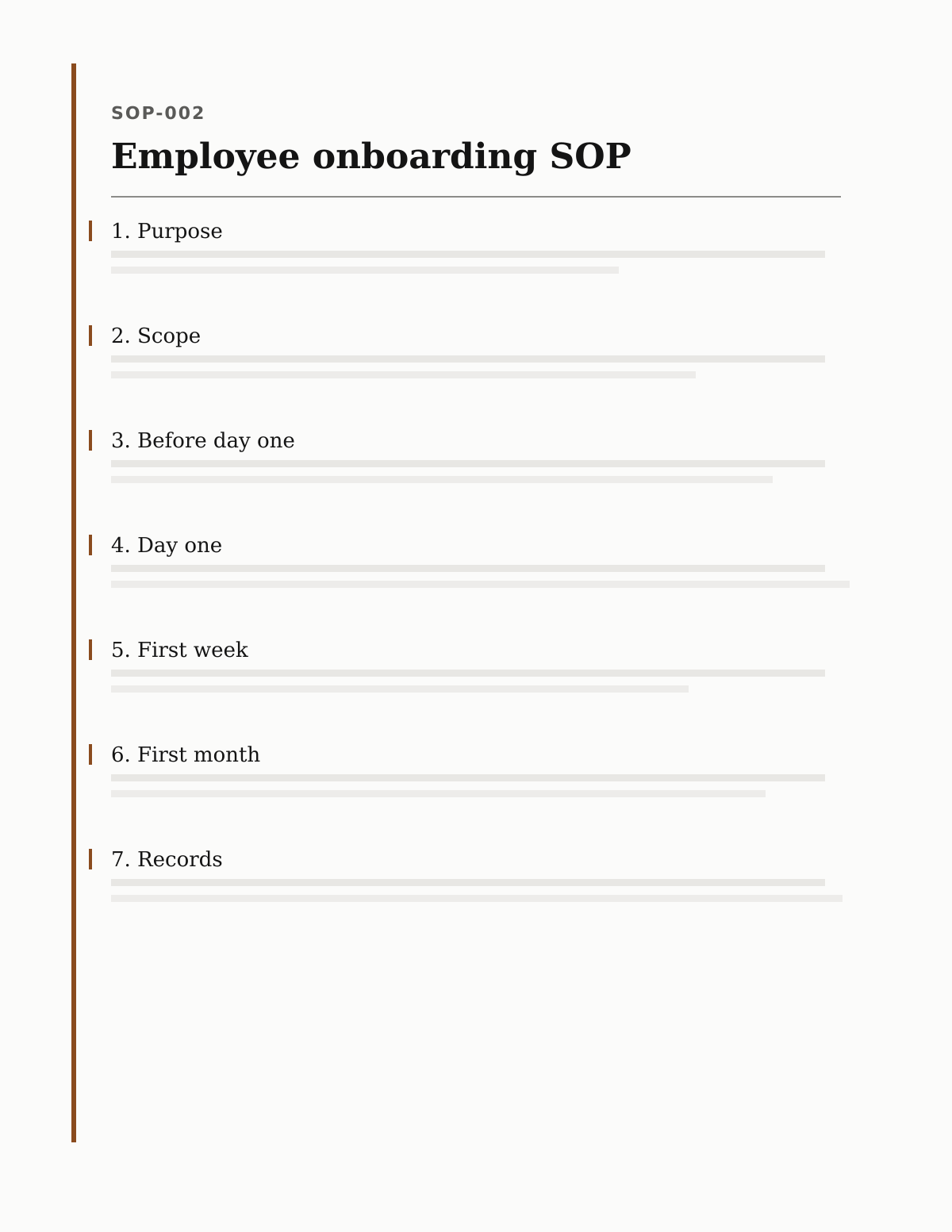
A repeatable sequence for bringing a new hire from accepted offer to productive first month, so nothing is left to memory or to whoever happens to be around.
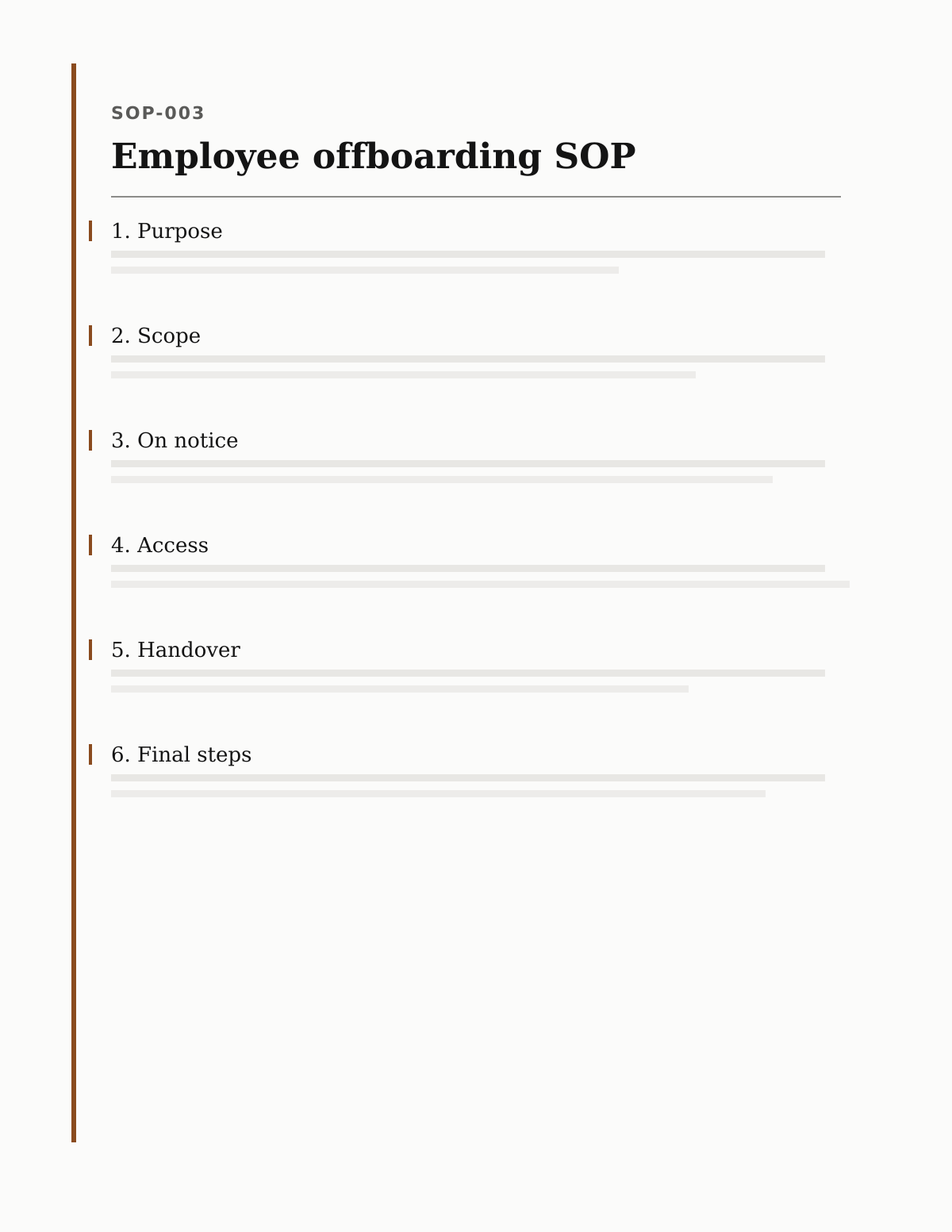
A complete, accountable sequence for ending a working relationship — access revoked, work handed over, records kept — so nothing is lost and no account is left live.
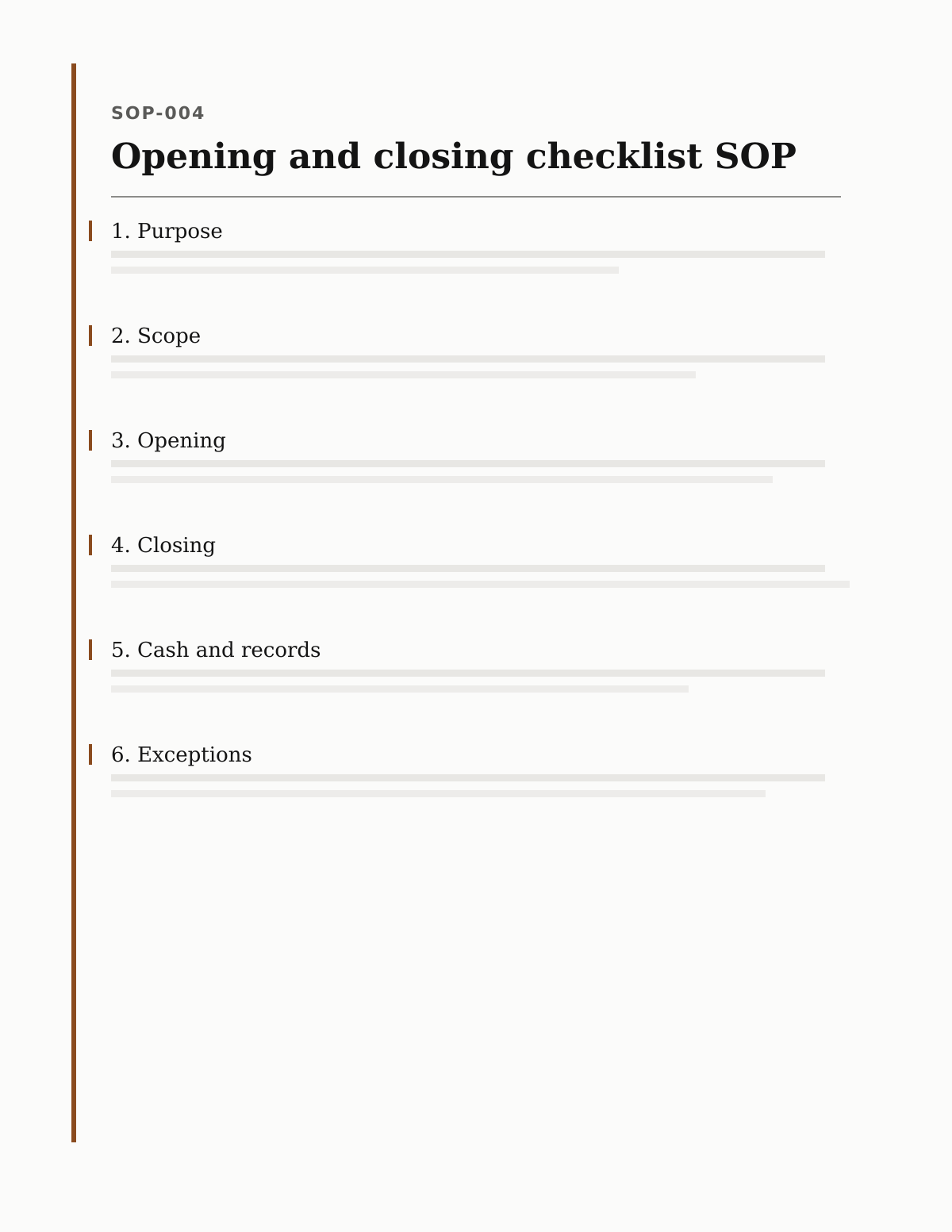
A single controlled checklist for opening and closing a premises or shift, so the same things are checked every time and a forgotten step has an owner.
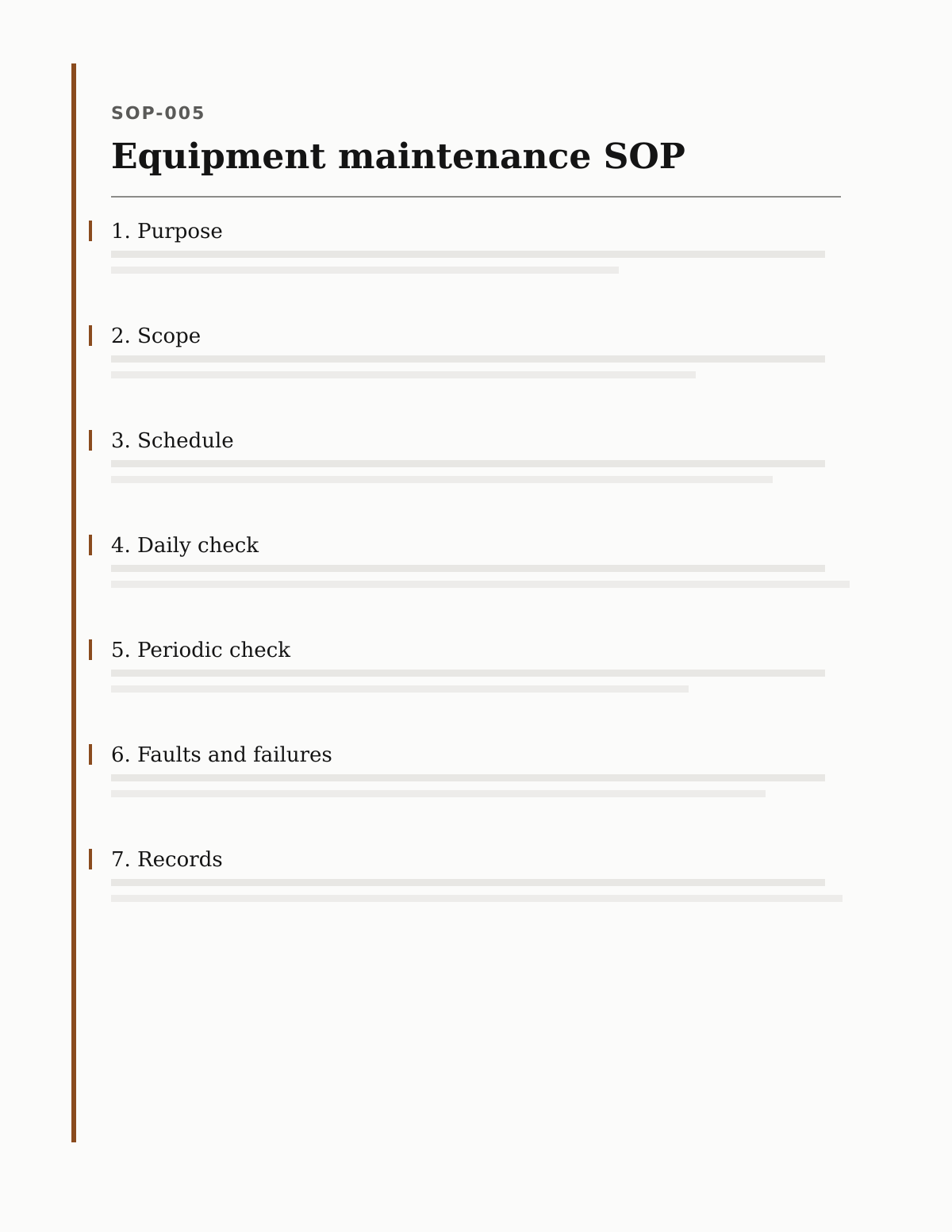
A controlled schedule for routine equipment checks and servicing, so maintenance happens on a calendar rather than after a breakdown.
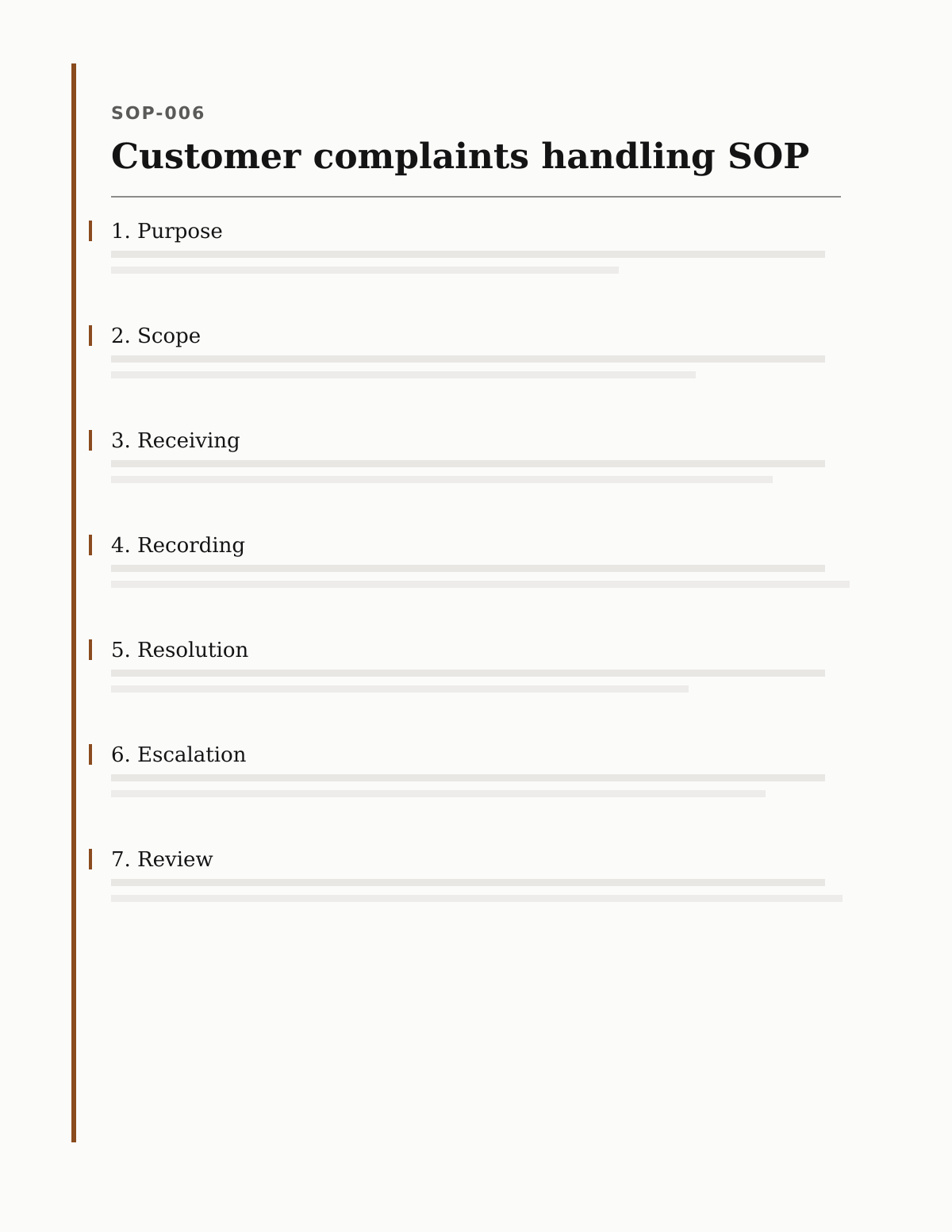
A consistent way to receive, record and resolve a customer complaint, so the same standard applies every time and a resolution is never lost.
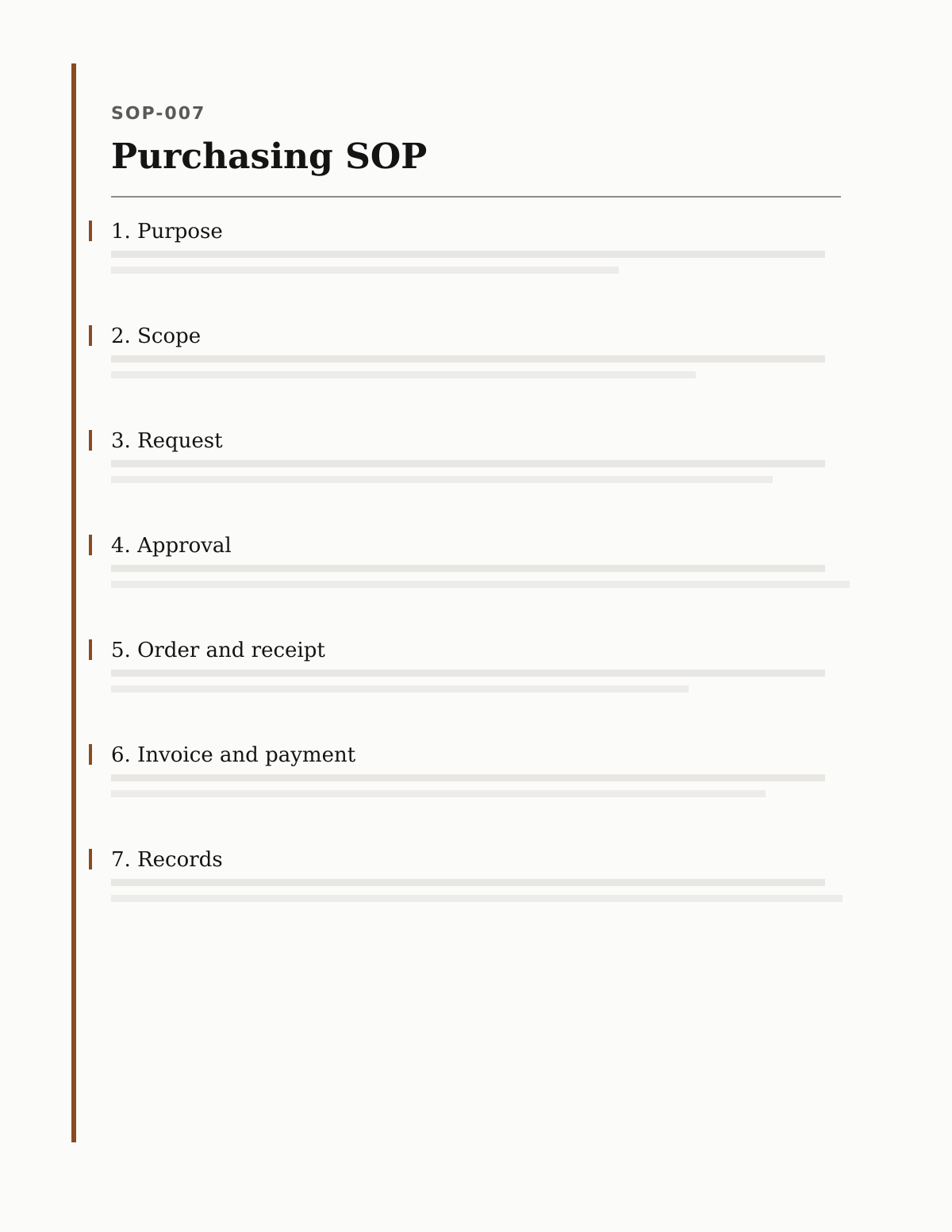
A controlled path from need to paid invoice, with an approval step at the point where money leaves, so purchases are authorised, recorded and traceable.
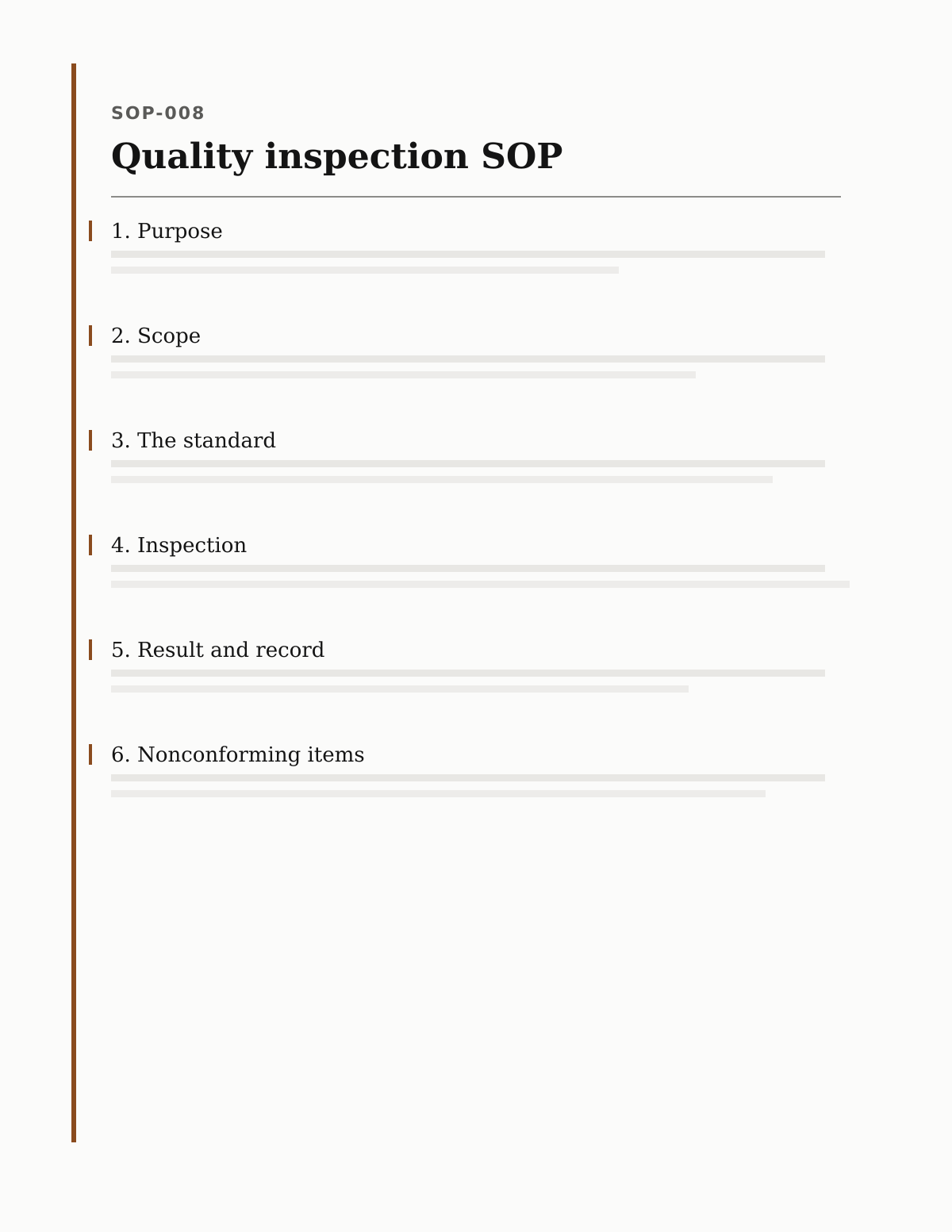
A repeatable inspection with a written result, so quality is checked against a fixed standard rather than a mood, and a failure has an owner.
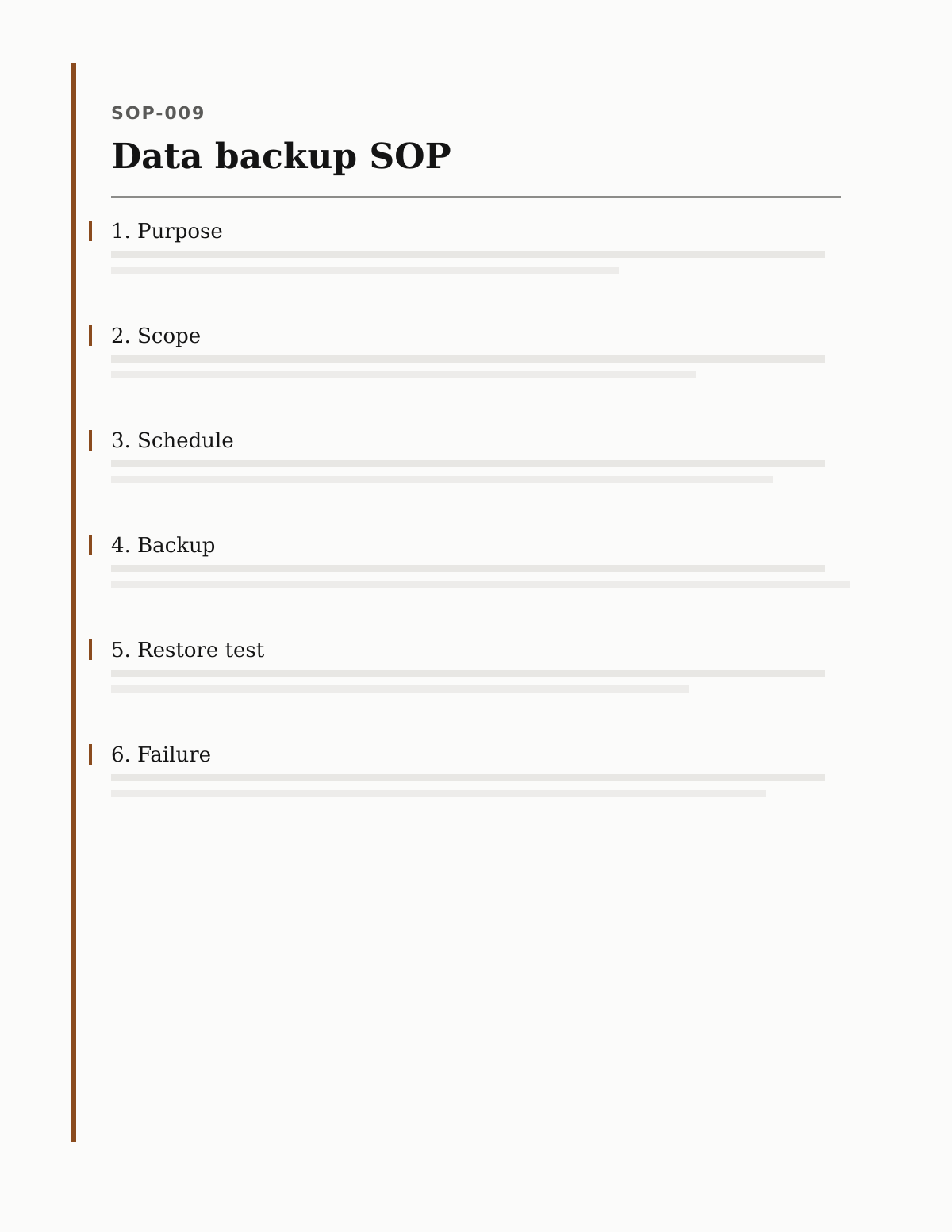
A scheduled, tested backup routine with an owner, so the data a business runs on survives a failure and the recovery has been proven, not assumed.
What makes an SOP survive an audit
The document that survives an audit is not the one with the most detail. It is the one with a number, an owner, a revision history and steps that match what actually happens. An auditor asks three things: who owns this, what version is current, and does the written step match the real one. If you cannot answer all three from the document in front of you, the procedure is not controlled.
The full method — how to write, test and roll out an SOP — is in the guide on writing an SOP.
If the procedure has to be edited in Word rather than filled in on a printed page, there is a SOP template for Word.
Common questions
- What should an SOP include?
- A standard operating procedure should include a stated purpose, the scope it covers, the roles responsible, any prerequisites, the numbered steps in order, what to do when a step goes wrong, and the records it leaves. This template lays out each section with a worked example filled in for a real process, so you can see what good looks like in the fields before you write your own.
- What is the difference between a policy and a procedure?
- A policy states the rule or the position; a procedure states the steps to carry that rule out in practice. A policy says a refund is available within 30 days. The procedure says exactly what a person does to issue one. Most teams need both, and a procedure without the policy behind it is steps without a reason.
- How do you write a standard operating procedure?
- Start from the person doing the work, not from the manager who wants it written. Write the steps in the order they happen, one action per step, and do not assume prior knowledge. State what to check where the path forks and what to do when a step cannot be completed. Then test it with someone who has never done the task and fix what they stumble on.
- Who is responsible for writing SOPs?
- Whoever does the work writes the draft, because they are the only person who knows how it actually happens. A manager reviews it for accuracy and approves it, and an owner keeps it current. The person named as the owner in the control block is the one who answers questions about it and approves changes.
Turn a folder of documents into something a team can actually find and follow
Every template on this site is free and stays free. The kit is what turns a folder of documents into a system you can actually run: a register with numbers, owners and review dates; who reviews what and how often; a numbering scheme that still works at fifty documents; and the thirty-day sequence for getting a team to use any of it, which is where most of these projects die.
Opens a short sponsor step, then brings you straight back to this page with the kit open. Nothing you have entered goes with you.